Proper Paver Joint Sand Height: Why It Matters Before Sealing
Learn why proper paver joint sand height matters before sealing, why Patriot uses ASTM C144 joint sand, and when polymeric sand is—or isn’t—necessary.
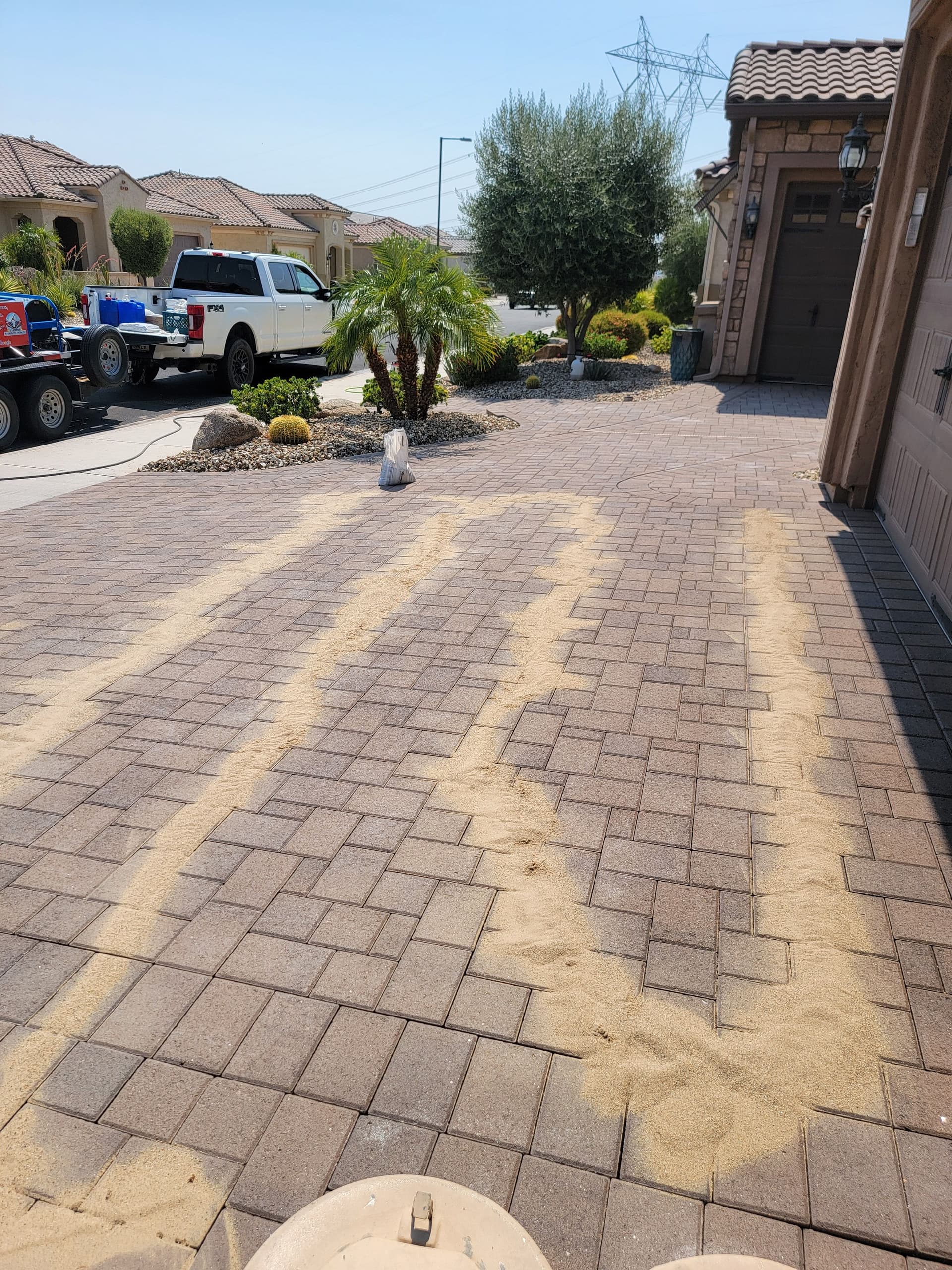
Why Proper Joint Sand Height Matters When Sealing Pavers in Arizona
When homeowners compare paver sealing companies, most focus on the sealer being used, how shiny the finished pavers will look, or how much the project costs.
But one of the most important details happens before the sealer ever comes out of the bucket:
The type, quality and height of the joint sand between your pavers.
At Patriot Paver Sealing AZ, we believe proper preparation is what separates a professional paver restoration from a rushed sealing job. Joint sand is a perfect example.
More sand does not mean a better job—and not all sand belongs between your pavers.
How High Should Joint Sand Be?
For most traditional concrete pavers with a beveled edge, also called a chamfer, properly installed joint sand should generally sit approximately:
1/8 inch below the bottom of the chamfer.
For non-beveled or tumbled pavers, the sand should typically remain approximately 1/8 inch below the top surface.
The goal is not to fill sand all the way to the top of the brick.
The exact appearance can vary depending on the paver style, but the principle remains the same:
The joint should be properly filled without being overfilled.
More Sand Isn't Better
One shortcut we occasionally see is excessive sand being swept into the joints until they are nearly flush with the surface of the pavers.
To a homeowner, that can initially look like the contractor gave them "more sand."
But more isn't necessarily better.
When joint sand is too high, excessive sand remains exposed near the surface and can become saturated with sealer. Instead of seeing clean, defined paver edges, the finished project may have wide, overly filled joints that distract from the appearance of the pavers.
Proper sanding takes attention to detail.
The goal isn't to use the most sand possible. The goal is to put the correct sand at the correct level.
The Type of Joint Sand Matters Too
Patriot Paver Sealing AZ does not simply purchase whatever inexpensive sand happens to be available.
For traditional joint-sand applications, we use properly graded joint sand that meets ASTM C144 specifications.
ASTM C144 establishes gradation requirements for sand used in masonry applications. For paver joints, that proper distribution of particle sizes helps the sand pack together and create a more stable joint.
Our preferred product is SEK-Surebond Joint Sand.
SEK-Surebond's joint sand is:
Clean and angular
Washed
Screened
Dried
Properly graded
ASTM C144 compliant
Specifically designed for segmental paver joints
Designed to work with joint-stabilizing sealers
That is very different from simply grabbing a bag of fine sand and sweeping it between the pavers.
We Don't Use Fine Silica Sand as a Cheap Substitute
Patriot does not substitute fine bagged silica sand for properly graded paver joint sand.
Very fine, uniformly sized material does not provide the same particle-size distribution we want when rebuilding paver joints.
We want a properly graded, angular jointing material designed to fill and interlock within the joint—not simply the cheapest sand available.
This is another detail most homeowners may never think to ask about.
But they should.
A good question for any paver contractor is:
"What kind of sand are you putting in my joints?"
If the answer is simply "sand," keep asking questions.
What About Polymeric Sand?
Polymeric sand absolutely has appropriate applications, and Patriot Paver Sealing AZ will use it when a specific project calls for it.
But we rarely need polymeric sand on our standard sealing projects.
Why?
Because the professional paver sealers we use are designed to provide joint stabilization as part of the sealing system.
When properly graded ASTM C144 joint sand is installed to the correct level and then treated with an appropriate joint-stabilizing sealer, the sealer penetrates into the joint and helps bind the sand together.
That means adding polymer binders to the sand itself is not automatically necessary.
In many of our projects, we prefer:
Proper ASTM C144 joint sand + professional joint-stabilizing sealer
rather than:
Polymeric sand + sealer
Polymeric sand remains another tool in the toolbox, but it is not something we use simply because it sounds more expensive or more impressive to the homeowner.
The material should fit the system.
Why We Prefer SEK-Surebond Joint Sand
SEK-Surebond specifically manufactures its Joint Sand for segmental pavement systems and for use with joint-stabilizing sealers.
It provides the clean, angular and properly graded material we're looking for before sealer application.
For Patriot, this fits directly into our overall philosophy:
Don't improvise the preparation and expect premium sealer to correct it later.
We want the joint structure correct before the first coat of sealer is ever applied.
What Happens When Joint Sand Is Too Low?
Overfilling is a problem, but insufficient sand isn't good either.
When joints have lost too much material, the pavement system can become more susceptible to:
Continued joint-sand erosion
Increased paver movement
Weed growth
Insect activity
Water penetrating deeper into the joints
An unfinished or poorly maintained appearance
This is why professional paver restoration often includes joint sand restoration after cleaning.
Deep cleaning can remove loose, contaminated or deteriorated material from the joints. Once the pavers are clean and properly prepared, those joints need to be inspected and restored to the appropriate level before sealing.
Joint Stabilization Starts With Proper Preparation
A quality paver sealer does more than change the color or sheen of the brick.
Professional sealing systems can also help stabilize joint sand.
Patriot Paver Sealing AZ commonly uses professional SurfaceLogix products, including Cobble Loc, which is designed to both enhance concrete pavers and stabilize joint sand.
But even a premium sealer can only work with the preparation underneath it.
If the joints are poorly prepared, inconsistently filled, filled with the wrong material, or packed excessively high, putting expensive sealer over them doesn't suddenly correct those problems.
That's why we say:
Great sealer cannot fix poor preparation.
Proper Joint Sand Is Part of a Bigger Process
Joint height shouldn't be treated as an isolated step.
At Patriot Paver Sealing AZ, our paver restoration and sealing process focuses on:
Inspecting the existing pavers
Treating problem areas
Deep cleaning the surface
Properly preparing and neutralizing the pavers when required
Installing ASTM C144 joint sand to the proper level
Allowing adequate drying and inspection time
Professionally applying commercial-grade sealer
We don't believe in rushing through preparation just to get sealer on the ground faster.
Why This Matters in Arizona
Arizona pavers take a beating.
Intense UV exposure, extreme surface temperatures, irrigation, vehicle traffic, dust and seasonal weather all affect exterior hardscapes.
That makes proper preparation especially important.
Homeowners throughout Surprise, Waddell, Verrado, Sun City Festival, Sun City West, Buckeye, Goodyear, Sterling Grove, Victory at Verrado, Trilogy at Wickenburg Ranch and other West Valley communities invest heavily in their paver driveways, patios and walkways.
Protecting that investment shouldn't begin with:
"How fast can we seal it?"
It should begin with:
"Is everything underneath the sealer being done correctly?"
The type and level of joint sand are two details we inspect before moving forward.
Questions to Ask Before Hiring a Paver Sealing Company
If you're getting estimates for paver sealing, ask:
Where should the joint sand sit before you seal my pavers?
Then ask:
What type of joint sand do you use?
Does your joint sand meet ASTM C144 specifications?
Do you fill the joints flush with the top of the pavers?
Why are you recommending polymeric or non-polymeric joint sand?
Does your sealer stabilize the joint sand?
How are the pavers cleaned before sealing?
How do you determine whether the surface is ready to seal?
What sealer do you use?
How is the sealer applied?
A professional contractor should be able to explain why each material and step is being used, not simply tell you how many coats you're getting.
Paver Sealing Done Right in Arizona's West Valley
At Patriot Paver Sealing AZ, we don't believe paver sealing should be a race to see who can finish the fastest or use the cheapest materials.
We focus on details homeowners may not immediately notice—but that can make a major difference in the finished project.
Proper ASTM C144 joint sand.
Proper joint height.
Superior surface preparation.
Commercial-grade products.
Professional electric spray application.
And a process designed around Arizona conditions.
If your pavers are faded, losing joint sand, overdue for maintenance, or ready for professional cleaning and sealing, Patriot Paver Sealing AZ serves homeowners throughout Surprise and Arizona's West Valley.
Paver sealing isn't just about what goes on top of the pavers. It's about getting everything underneath the sealer right first.